East Africa vs Southern Africa Safari : Which Is Best?
“East Africa vs Southern Africa” is usually the first real fork in the road once a traveler commits to an African safari, and in our experience it is also the decision that causes the most hesitation. Both regions deliver on the same core promise: open landscapes, extraordinary wildlife, and the particular quiet of a bush camp at night.
But how you get there, what you actually see once you arrive, and what the rest of your trip looks like differ enough that treating “Africa” as one interchangeable destination leads to disappointment more often than people expect.
We have spent years building tailor-made itineraries across Kenya, Tanzania, South Africa, Botswana, Namibia and Zimbabwe, and the honest answer is that neither region is objectively better. There is only the region that suits the traveler asking the question.
This guide sets out the real differences, category by category: wildlife and scenery, the Great Migration versus year-round Big Five viewing, cost, flight times and logistics, malaria-free options, self-drive versus guided travel, family-friendliness, and how each region pairs with an add-on trip.
We have included specific numbers wherever they help with planning — flight durations, price ranges, migration months — because vague reassurance is not much use when you are weighing a significant trip. By the end, you should know which region fits your dates, your budget and the people you are traveling with, or at least know exactly which questions to ask us next.
At a Glance: East Africa vs Southern Africa
Before the detail, here is how the two regions compare on the factors that matter most when you are deciding.
| Category | East Africa (Kenya & Tanzania) | Southern Africa (SA, Botswana, Namibia, Zimbabwe) |
| Wildlife & Scenery | Open savanna plains, Ngorongoro Crater; the classic “big sky” safari image | Bushveld, Okavango Delta wetlands, desert dunes, Victoria Falls — more varied landscapes |
| Great Migration | Yes — 1.5 million wildebeest; peak Mara River crossings Aug–Sept | No mass migration; year-round resident herds and Africa’s largest elephant concentrations |
| Typical Cost (mid-range, pp/day) | $350–$900, depending on season | $250–$700; self-drive can lower this further |
| Flights & Logistics | ~9 hrs from London to Nairobi; light-aircraft transfers between parks | ~11–12 hrs from London; road transfers and self-drive possible in Kruger/Namibia |
| Malaria Risk | Present in most parks; lower risk in the Ngorongoro highlands | Present in Kruger, the Delta and Chobe; extensive malaria-free reserves available |
| Self-Drive Option | No — guiding is required by law in Tanzania and standard in Kenya | Yes — Kruger, Etosha and the Garden Route are all self-drive friendly |
| Family-Friendliness | Good for children 8+; camps often set higher minimum ages | Excellent for young children via malaria-free, purpose-built family reserves |
| Popular Add-Ons | Zanzibar beaches, Rwanda gorilla trekking | Victoria Falls, Cape Town & the Winelands, Okavango Delta |
Figures are 2026 mid-range guidelines and move with season, lodge category and group size; peak migration and Christmas/New Year dates run higher in both regions.
Wildlife and Scenery: How Different Are They, Really?
Every safari brochure uses the same handful of adjectives, so it is a fair question: does the landscape actually look different between the two regions, or is it mostly marketing? It looks different, and the difference is one of the most reliable ways to decide which region matches the picture in your head.
East Africa’s signature landscape is open, short-grass savanna running to the horizon in every direction — the Maasai Mara and Serengeti plains, punctuated by flat-topped acacia trees, and, in the Ngorongoro Crater, a self-contained caldera floor that concentrates wildlife into roughly 100 square miles ringed by a volcanic wall.
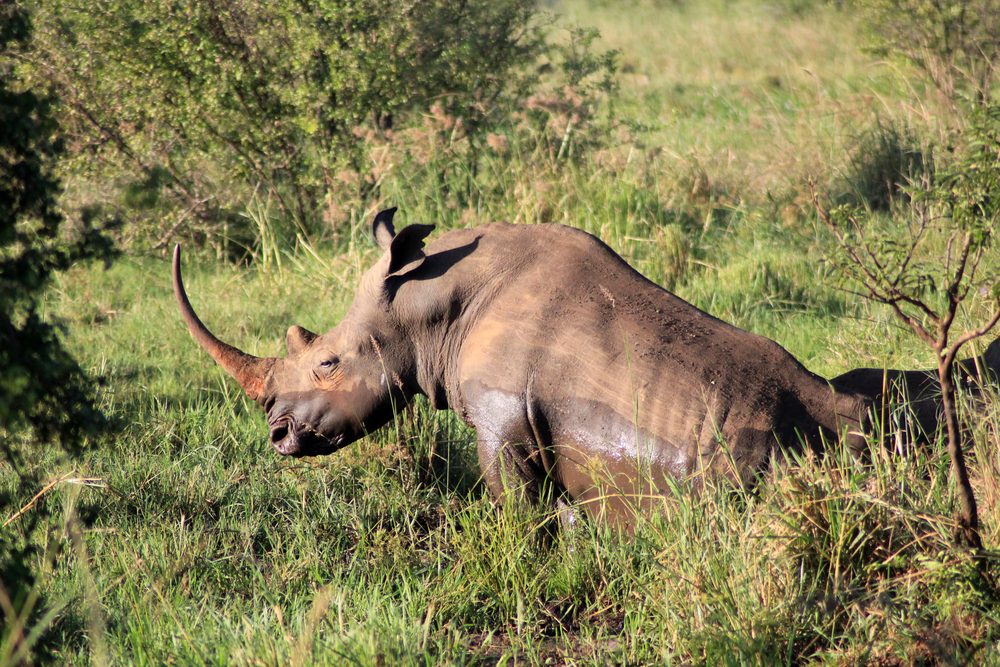
It is the view most people picture when they hear the word “safari,” and it delivers exactly that. Southern Africa trades that single dominant landscape for variety within one trip. Kruger and the private reserves around it sit in denser mopane and knob-thorn bushveld, with tighter sightlines than the Mara’s open plains.
The Okavango Delta is a genuine outlier: a permanent inland river delta in the middle of the Kalahari, where you move between islands by mokoro canoe and motorboat as often as by vehicle. Namibia adds towering red dunes at Sossusvlei and desert-adapted elephants, while the Zambezi River tips over Victoria Falls at the region’s eastern edge.
If the image that drew you to a safari in the first place is an endless golden plain full of grazing herds, East Africa delivers that scene more purely than anywhere else on the continent. If you would rather build one trip around several distinct landscapes — savanna, delta, desert, waterfall — Southern Africa’s geography does more of that work inside a single itinerary.
The Great Migration vs Year-Round Big Five Viewing
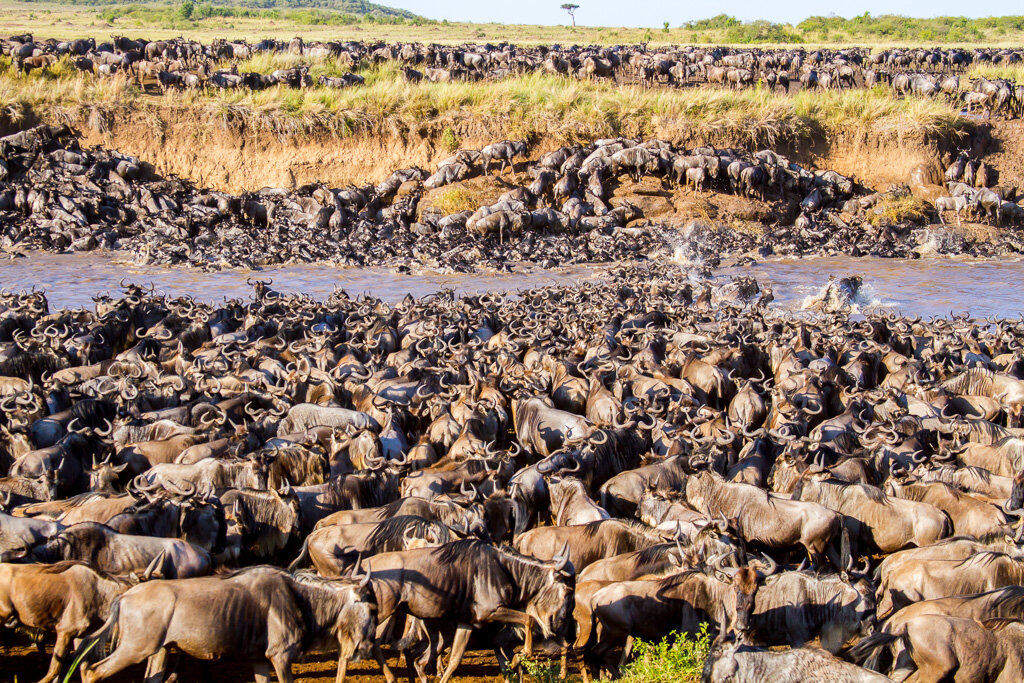
Where are you more likely to see dramatic wildlife action, and see it reliably rather than by chance? The answer depends on whether you are chasing one specific spectacle or want dependable game viewing regardless of the calendar. East Africa is home to the Great Migration, roughly 1.5 million wildebeest along with hundreds of thousands of zebra and gazelle, moving in a rough clockwise loop between the Serengeti and the Maasai Mara.
The most sought-after moment, herds crossing the Mara River while crocodiles wait in the current, typically happens between late July and early October, with peak activity most years falling in August and September. It is genuinely spectacular and worth planning a trip around, but it comes with a caveat we always flag to clients: the migration follows rainfall, not a calendar, so even a well-timed trip is not a guarantee of a crossing on the specific days you are there.
Outside those months, East Africa still delivers strong wildlife viewing, particularly in the Ngorongoro Crater, where a resident, non-migratory population keeps predator density high year-round. Southern Africa works differently: there is no equivalent mass migration, but permanent water sources keep resident wildlife in place all year.
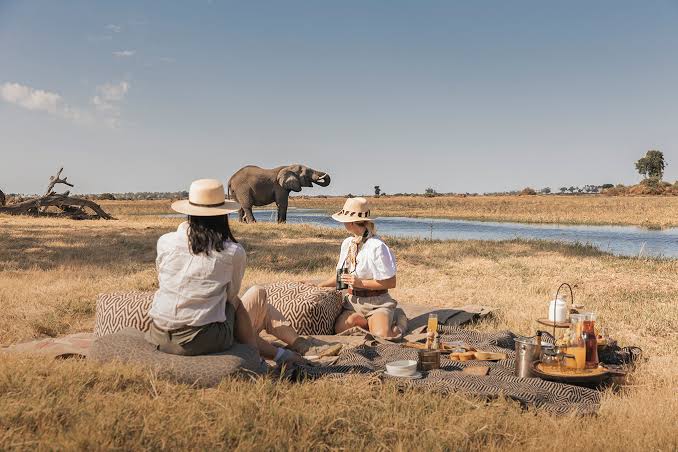
Kruger and its neighboring private reserves offer consistent Big Five sightings in almost any month, and Chobe National Park in Botswana holds one of the largest elephant concentrations anywhere in Africa, most visible from the water during the dry season from July to October.
If your trip is built around one specific, bucket-list scene and you can commit to August or September travel, East Africa is the stronger bet. If your dates are fixed by work or school terms and you need dependable wildlife viewing regardless of which month that turns out to be, Southern Africa’s resident populations remove much of that timing risk.
Cost: Which Region Costs Less?
Cost is rarely the only factor, but it does shape which region and which style of trip makes sense, so it is worth being specific rather than vague about it. As a general rule, Southern Africa is the lower-cost region, largely because of a favorable exchange rate against the US dollar and pound, well-developed infrastructure, and, in South Africa specifically, the option to self-drive rather than pay for guided vehicles.
Mid-range East Africa safaris typically run $350 to $600 per person per day in shoulder season and $500 to $900 during the July-to-October peak, reflecting higher park fees and the near-universal requirement for a guided vehicle.
Southern Africa’s mid-range equivalent generally runs lower, and self-drive changes the math further: a week self-driving through Kruger, including a rental vehicle, fuel, park fees and self-catered accommodation, typically costs $500 to $800 per person for the entire week, compared with $100 to $300 per person for a single guided game drive elsewhere. At the luxury end the gap narrows considerably.
A seven-night stay at a top-tier lodge runs $5,700 to $9,000 or more per person in either region, since you are largely paying for the same standard of camp, food and guiding rather than the underlying geography.
The most cost-effective travel windows in both regions are the green seasons — roughly November to April in Southern Africa and April to May in East Africa — when lodges often drop rates and waive single-supplement fees. Budget-conscious travelers and anyone drawn to self-drive should lean toward Southern Africa; travelers set on a specific migration-season trip should expect East Africa’s peak-season premium and budget accordingly.
Flights and Logistics: Getting There and Getting Around
How much of your trip gets spent traveling rather than on safari, and does it matter which region you choose? The answer depends more on which country you are flying from than on any inherent advantage of one region. From London, Nairobi is around nine hours direct, noticeably shorter than the roughly eleven-and-a-half hours to Johannesburg or twelve to Cape Town, giving East Africa a real edge for UK and European travelers.
From the US East Coast, the comparison flips: New York to Johannesburg runs about fifteen hours direct, while New York to Nairobi takes roughly fourteen, and there is no direct US flight to Tanzania at all, so reaching Kilimanjaro or Arusha from North America typically takes seventeen hours or more once a connection is added. For US-based travelers, Southern Africa’s direct Johannesburg routing is often the faster door-to-door option.
Once you land, the two regions handle internal logistics differently. East Africa relies heavily on light-aircraft transfers between parks — a 45-minute to one-hour hop between Nairobi or Arusha and camps in the Mara or Serengeti — because road distances are long and the roads themselves are rough. Southern Africa allows more flexibility: the Kruger region is reachable by paved road and domestic flight, making road transfers and self-drive genuinely practical, while reaching the Okavango Delta or more remote Namibian camps still requires light aircraft, much like East Africa.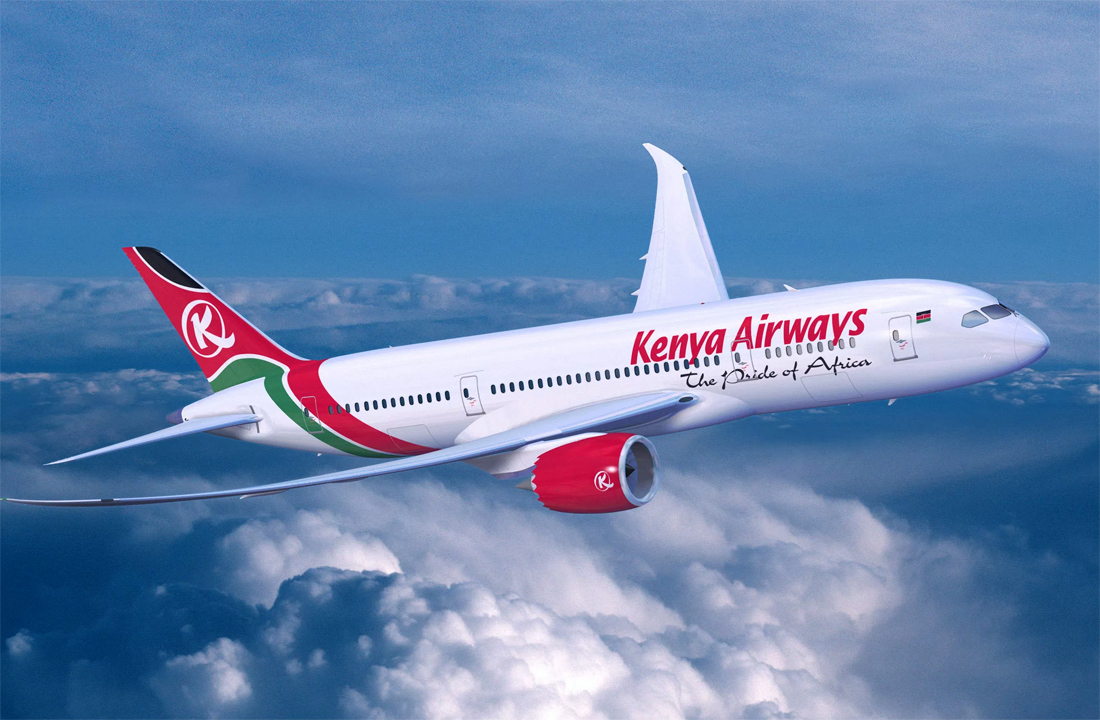
Neither region is a quick trip from outside Africa, and we always advise building at least one buffer day into the schedule on either end in case of a delayed connection, a detail that matters more than people expect when the domestic leg is a small charter rather than a scheduled airline.
Malaria-Free Options: What Families Actually Need to Know
Isn’t Southern Africa automatically the safer choice for a family because of its malaria-free parks? It has more malaria-free options, but the picture is more nuanced than a flat yes. Malaria risk in both regions is concentrated in low-lying, warmer areas and drops sharply in the dry winter months, roughly June through October, when mosquito populations and transmission risk are both at their lowest.
South Africa has built an entire category of reserves specifically around avoiding the issue altogether: Madikwe Game Reserve and Pilanesberg National Park near the Botswana border, the Eastern Cape’s Addo Elephant National Park, and the Waterberg region’s Welgevonden and Marataba reserves, all malaria-free and all offering genuine Big Five game viewing without compromising on wildlife quality. This matters because standard antimalarial medication is generally not recommended for children under five or for pregnant travelers, so a malaria-free reserve removes the decision entirely rather than requiring a judgment call about acceptable risk.
East Africa does not offer an equivalent network of malaria-free Big Five reserves; the Mara, Serengeti and Tarangire all sit within malaria zones, though the Ngorongoro Crater’s high altitude and cool nighttime temperatures make it a comparatively lower-risk stop within an itinerary. Kruger, the Okavango Delta and Chobe also carry malaria risk and are not exempt simply because they sit in Southern Africa; the malaria-free reserves are specific, named properties, not a blanket regional guarantee.
For families with children under five, pregnant travelers, or anyone who would rather not take antimalarial medication on principle, South Africa’s malaria-free reserves are the more straightforward answer. For families with older children, or anyone comfortable taking standard precautions and traveling in the dry season, both regions are realistic options, and the decision can be made on other grounds instead.
Self-Drive or Guided: How Much Control Do You Want Behind the Wheel?
Can you drive yourself around on safari, or are you always in someone else’s hands? It depends entirely on which region you choose, and this is one of the sharpest differences between the two. Tanzania requires a licensed guide by law in its national parks, and Kenya’s reserves and conservancies operate the same way in practice, so East Africa is guided-only territory regardless of budget or experience level.
Southern Africa is the opposite case: Kruger National Park and Namibia’s Etosha National Park are both built for confident self-drive travel, with paved or well-maintained gravel roads, clear signage, and rest camps spaced for a full day’s driving. Self-driving a week through Kruger, including car rental, fuel, park fees and simple accommodation, typically runs $500 to $800 per person for the entire week, a fraction of paying for guided drives throughout.
It is worth being honest about the trade-off: self-drive visitors generally see the same animals as guided visitors, since everyone shares the same road network, but a professional guide’s radio network, tracking knowledge and ability to read animal behavior tend to improve both the frequency of sightings and your understanding of what you are watching.
Independent travelers, repeat safari-goers who already know what they are looking for, and budget-conscious families often prefer the control and lower cost of self-driving through Kruger or Etosha. First-time visitors, anyone who wants expert interpretation rather than just a sighting, and every traveler heading to Kenya or Tanzania should plan on a guided vehicle, since it is either legally required or simply the far better way to experience those parks’ wildlife density.
Family-Friendliness
Which region works better once young children are part of the trip? Southern Africa generally has the practical edge for families with children under six, largely for the malaria reasons already covered, but the full picture involves more than medication.
Many South African lodges in malaria-free reserves set minimum ages as low as four to six years old, run dedicated kids’ programs such as junior ranger activities at Madikwe, and offer family suites with interconnecting rooms, features built around shorter attention spans and earlier bedtimes rather than adapted from an adult-first itinerary.
Self-drive Kruger adds another family-specific advantage: your own vehicle means your own schedule, with no early wake-up call shared with strangers in a guided vehicle. East Africa’s camps tend to set higher minimum ages, often six to twelve, because vehicles are open-sided and wildlife density is higher, leaving less room for a curious toddler to move freely during a drive.
That said, East Africa can be an outstanding family destination for children eight and older or teenagers: the drama of the Great Migration, Maasai cultural visits, and the sheer scale of the Serengeti’s plains tend to leave a bigger impression on children old enough to understand what they are watching than a more sedate malaria-free reserve might.
Our practical guidance: families with children under six, or anyone who wants malaria out of the equation entirely, should lean toward South Africa’s malaria-free reserves. Families with older children or teenagers looking for a genuine bucket-list trip can safari confidently in either region, and East Africa’s migration season is well worth considering once the children are old enough to appreciate it.
Combining Your Safari With Other Travel
Does either region pair better with a non-safari add-on? Both connect naturally to an iconic extension, just different kinds, so this should rarely be the deciding factor on its own, but it is worth knowing what is realistic.
Southern Africa itineraries commonly combine a Kruger-area safari with Victoria Falls, one of the most dramatic waterfalls on the planet, straddling the Zambezi River between Zambia and Zimbabwe, with white-water rafting, bungee jumping and microlight flights available around it, and with Cape Town, where a few days of Table Mountain, the Winelands and the Garden Route round out a trip that already spans wildlife, adventure and city travel.
Because road and flight infrastructure across South Africa, Botswana and Zimbabwe is well developed, stitching two or three of these destinations into one itinerary is straightforward. East Africa’s most natural add-on is Zanzibar, the island archipelago off Tanzania’s coast, reachable by a short flight from Arusha, Dar es Salaam or Nairobi. After a week of early-morning game drives, a few days on Zanzibar’s white-sand beaches at Matemwe or Kiwengwa, with Stone Town’s old quarter and spice farms nearby, offers a genuine reset before the long flight home.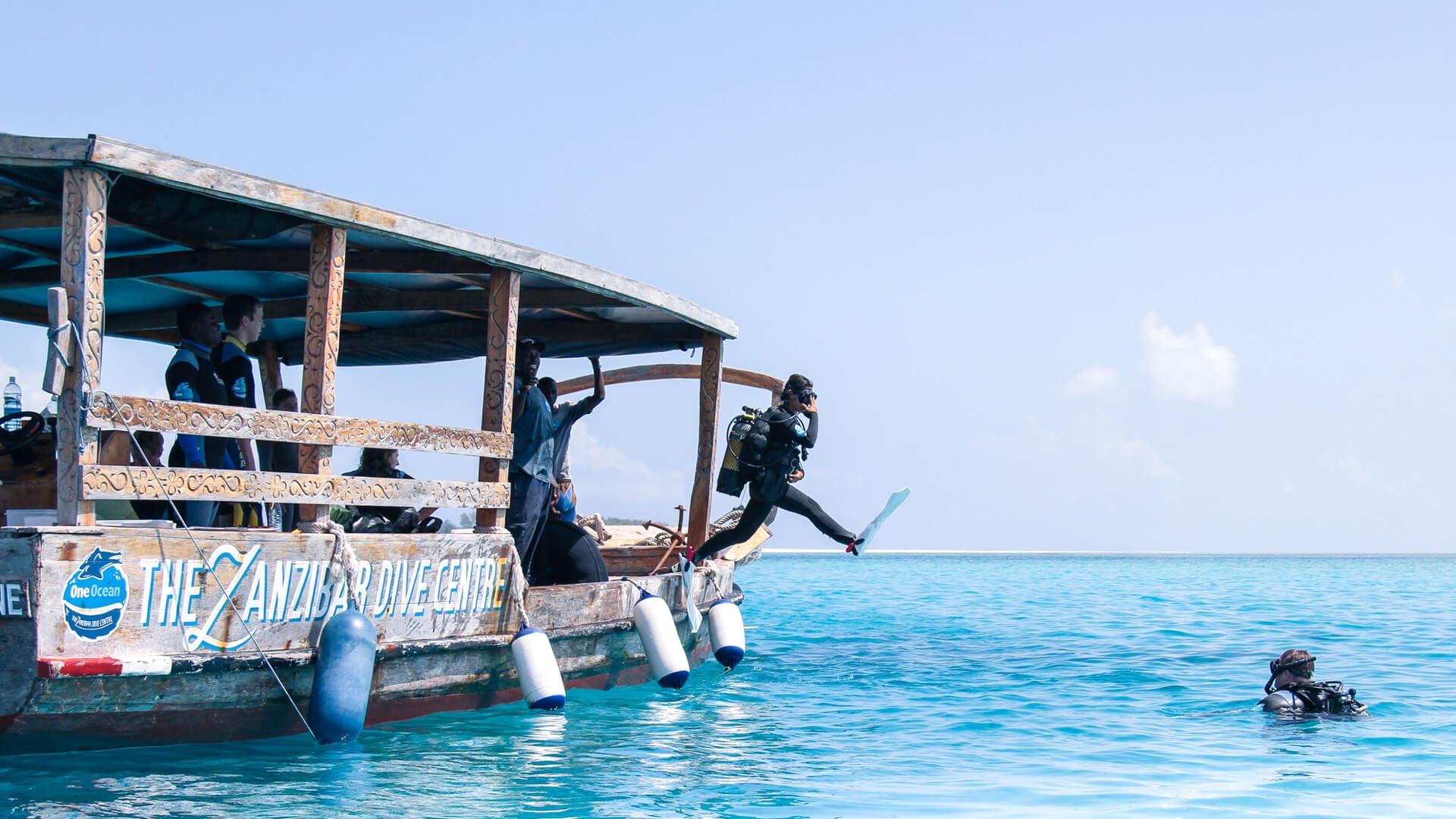
Kenya’s own coast around Diani offers a similar, closer beach option for safaris that stay entirely within Kenya, and Rwanda’s gorilla trekking is a further, more adventurous add-on for travelers extending an East Africa trip inland rather than to the coast. If you picture your trip ending with a few days of wine and city views, Southern Africa’s Cape Town extension is the more natural fit. If you picture it ending on a beach with very little required of you, East Africa’s Zanzibar extension does that better.
Recommendations by Traveler Type
None of the categories above declares an outright winner, on purpose. The right region depends on who is traveling and what they need most from the trip, so here is our direct guidance by traveler profile.
- First-timers: East Africa if the Great Migration and classic savanna scenery are the priority, especially for August or September travel; Southern Africa if you would rather see Cape Town, Victoria Falls and the bush within one trip. Both regions make an excellent introduction to the safari.
- Families with young children (under 6): South Africa’s malaria-free reserves — Madikwe, Pilanesberg, the Waterberg — remove the antimalarial question entirely and are purpose-built for young families.
- Repeat safari-goers: consider whichever region you have not yet done, or go deeper into the one you have. Namibia or Zambia offer something different in the south; Tanzania’s southern circuit (Ruaha, Nyerere) offers East Africa without the Mara’s crowds.
- Honeymooners: East Africa for classic romance and a shot at the migration; Southern Africa for private villas, a Cape Town finish, and easier logistics on a longer, multi-stop trip.
- Adventure and self-drive travelers: Southern Africa — self-drive through Kruger and Etosha, Victoria Falls adrenaline activities, and mokoro trips through the Okavango Delta.
- Budget-conscious travelers: Southern Africa generally offers the lower entry price, particularly with self-drive Kruger. East Africa budget camping safaris exist but tend to cost more overall once park fees and mandatory guiding are factored in.
Frequently Asked Questions
Which is better for a first safari, East Africa or Southern Africa?
Neither is objectively better for a first trip; it depends on what you want most. Choose East Africa if seeing the Great Migration or the classic open-savanna scenery matters to you. Choose Southern Africa if you would rather combine wildlife with city travel, wine country, or Victoria Falls in one itinerary, or if you want the option to self-drive.
Which is cheaper, East Africa or Southern Africa?
Southern Africa is generally the lower-cost region, thanks to a favorable exchange rate and, in South Africa, the option to self-drive. East Africa costs more on average, particularly during the July-to-October migration season, when demand for camps along the Mara River peaks.
Is Southern Africa safer for young children because of malaria?
It offers more built-in reassurance. South Africa has an established network of malaria-free, Big Five reserves — Madikwe, Pilanesberg, the Waterberg — that remove the antimalarial question for children under five and pregnant travelers. East Africa does not have an equivalent network, though the Ngorongoro Crater carries comparatively lower risk than the Mara or Serengeti lowlands.
Can I combine an East Africa and Southern Africa safari in one trip?
It is possible, but it is a demanding itinerary rather than a casual add-on. The flight between Nairobi and Johannesburg runs four to five hours, and combining both regions properly, rather than rushing either, generally needs three weeks or more. Most travelers are better served booking one region well and returning for the other on a future trip.
When is the best time to see the Great Migration?
The Mara River crossings are most likely between late July and early October, with peak activity in most years falling in August and September. The migration follows rainfall rather than a fixed calendar, so treat these as strong probabilities, not guarantees, and build in several full days near the crossing points rather than a single rushed visit.
Do East Africa and Southern Africa have different visa and health requirements?
Yes. Kenya and Tanzania both use an online e-visa system, and a yellow fever certificate is required only if you are arriving from a country with yellow fever risk. South Africa is visa-free for many nationalities for short stays, while Botswana, Namibia and Zimbabwe requirements vary by nationality, so it is worth checking each country on a multi-destination Southern Africa trip individually.
Is self-drive safe in Kruger National Park?
Yes, for confident, cautious drivers. Roads are well maintained, signage is clear, and rest camps are spaced for a comfortable day’s driving. Self-drive visitors use the same road network as guided vehicles and see broadly the same wildlife, though a guide’s tracking knowledge and radio network typically improve both the number of sightings and the context behind them.