Why Kenya And Uganda Is A Perfect Safari Pair?
Why Kenya And Uganda Is A Perfect Safari Pair? Kenya and Uganda are not interchangeable safari destinations; they are complementary ones. Each country does something the other cannot, and the space between them, bridged by a short flight from Entebbe to Nairobi, is where the most complete East Africa safari itinerary in the world lives.
Kenya gives you the open savannah, the Big Five, the spectacle of the wildebeest migration, and a safari culture refined over more than a century. Uganda gives you ancient rainforest, mountain gorillas, chimpanzees swinging through the canopy, the thundering force of Murchison Falls, and a wildlife diversity that makes serious naturalists go quiet the same way that silverback did.
What Kenya Offers
Kenya has been the gateway to the African safari experience for well over a century, and that heritage shows in everything from the quality of its guiding community to the density of its park infrastructure. It does the classic African savannah safari better than almost anywhere else in the world, and it does it with a logistical ease that makes it the natural starting point for a combined trip.
The Maasai Mara:
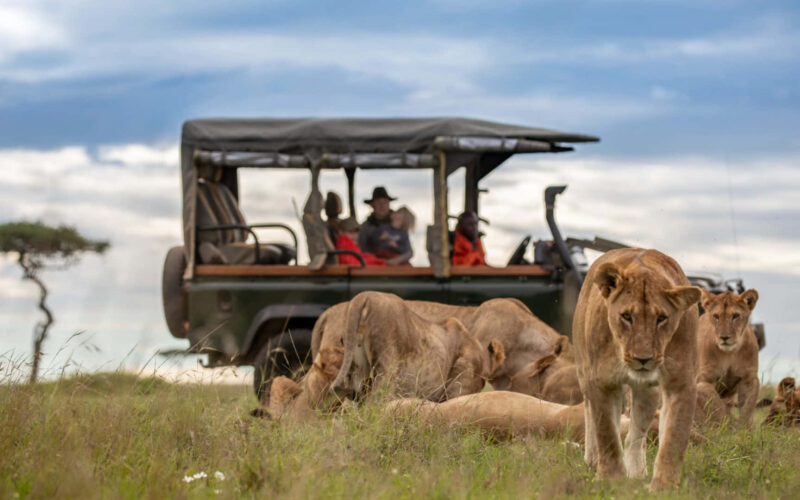
The Maasai Mara National Reserve sits at the northern end of the Serengeti-Mara ecosystem and is one of the most productive wildlife areas on earth. The Big Five are present year-round. Lion sightings are remarkably consistent, with one of the highest lion densities in Africa concentrated in a relatively compact reserve. Cheetah, leopard, elephant, giraffe, zebra, hippo, and hundreds of bird species are part of the standard daily viewing.
The reserve’s open plains mean wildlife is visible at distance without requiring hours of driving between sightings, which makes game drives consistently productive even in a vehicle with travelers who have never been on safari before.
Between July and October, the Great Wildebeest Migration crosses into Kenya from Tanzania’s Serengeti, bringing over 1.5 million wildebeest, zebra, and gazelle with them. The Mara River crossings during this period are one of the world’s great wildlife spectacles.
Hundreds of thousands of animals plunge into crocodile-filled water in a chaotic surge that is equal parts terrifying and extraordinary. No documentary captures what it actually feels like to stand at the river bank when a crossing begins. The sound alone is something entirely its own.
Amboseli:
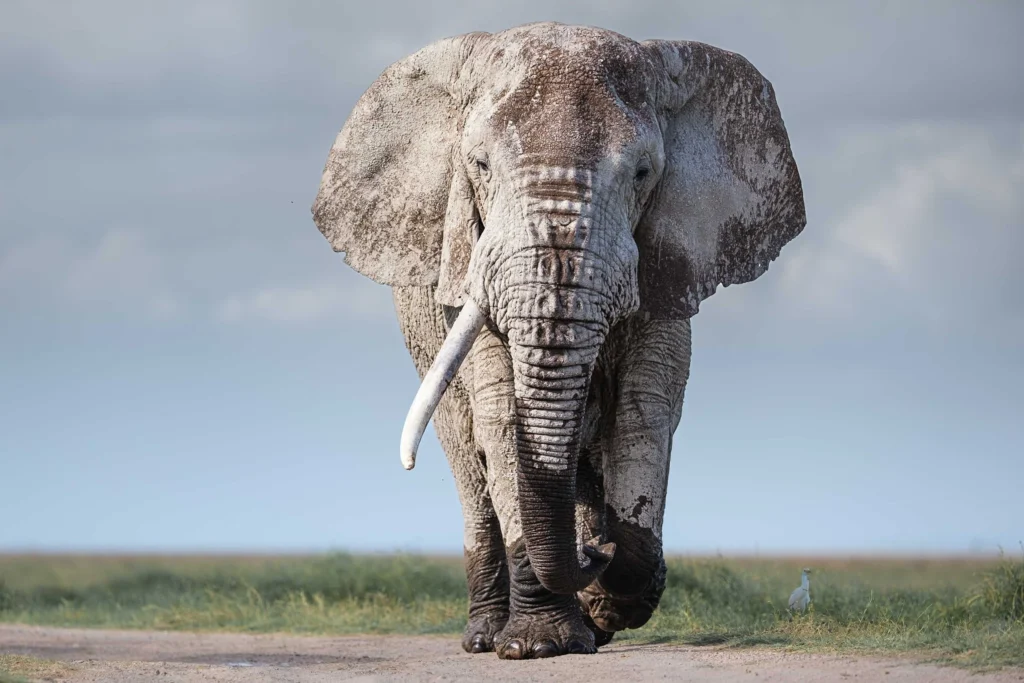
Amboseli National Park in southern Kenya offers a completely different register from the Maasai Mara but no less powerful. The park is famous for its large-tusked elephant herds moving across the dried lake bed with Mount Kilimanjaro rising above them on a clear morning, Africa’s highest mountain framing Africa’s largest land animal in a landscape photograph that writes itself. The open terrain makes wildlife spotting straightforward and the intimacy of the park, smaller and less trafficked than the Mara, gives game drives a quieter, more personal quality.
Lake Nakuru and the Rift Valley
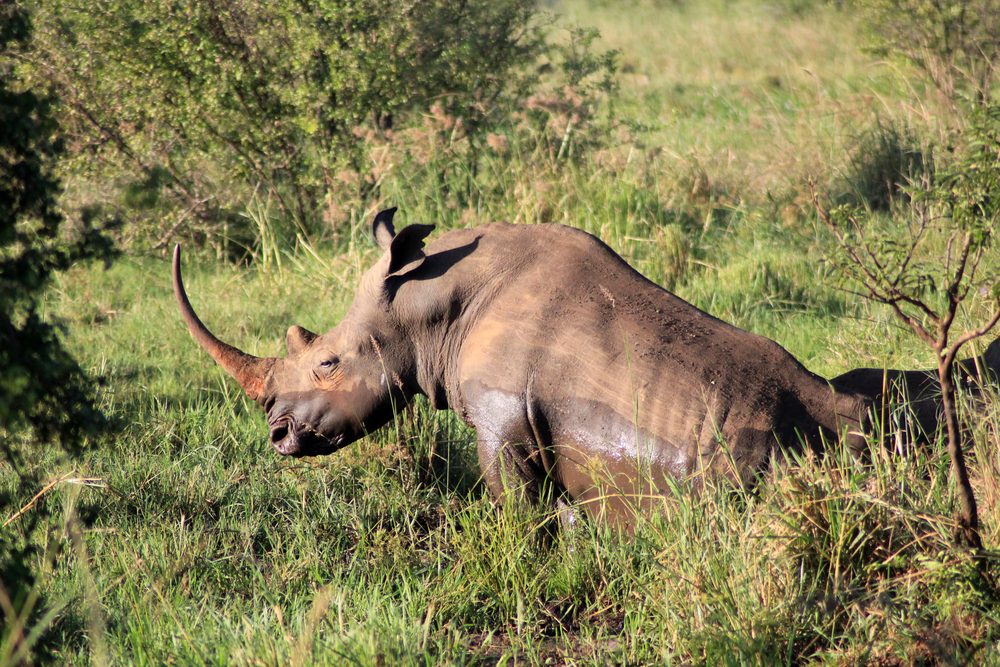
Lake Nakuru National Park in the Great Rift Valley adds rhino to the checklist (both black and white), along with concentrations of flamingo on the alkaline lake that turn its shores a shade of coral pink visible from the escarpment above. It functions well as a stop between Nairobi and the Maasai Mara or as a standalone day in a longer itinerary. The Rift Valley scenery surrounding Nakuru also provides a geographic context that helps travelers understand the geological forces that shaped East Africa.
Nairobi:
Nairobi is the hub through which most international travelers enter Kenya, and it adds its own experiences rather than simply functioning as a transit point. The Giraffe Centre, the David Sheldrick Wildlife Trust elephant orphanage at Nairobi National Park, and the city’s own national park, where lions and rhinos move against a Nairobi skyline backdrop, all reward a morning or afternoon stop. From Nairobi, flights to Entebbe connect in approximately ninety minutes, making the Kenya to Uganda leg of a combined trip genuinely easy.
What Uganda Offers
Uganda is called the Pearl of Africa, a title Winston Churchill gave it in 1908 and which the country has never needed to shed. Within a country the size of the United Kingdom, Uganda contains more recorded bird species than the entire North American continent, some of the most biologically diverse rainforests in Africa, the source of the Nile, half the world’s remaining mountain gorilla population, and a density of primate species that makes it the most important primate country on the planet. It is, to put it simply, an extraordinary place. It is also one that relatively few international travelers have explored, which gives the Uganda portion of a combined Kenya and Uganda safari an unmistakable quality of discovery.
Bwindi Impenetrable Forest:
Bwindi Impenetrable National Park in southwestern Uganda is a UNESCO World Heritage Site and home to approximately 430 mountain gorillas, more than half of the entire global population of this critically endangered species. The park contains 19 habituated gorilla families spread across four trekking sectors: Buhoma, Ruhija, Rushaga, and Nkuringo. Every morning, groups of eight visitors depart from each sector with an armed ranger escort and trackers who have already located the target family using radio communication. The trek through the forest takes anywhere from one hour to eight hours depending on the gorillas’ movements, and when you find them, you spend exactly one hour in their presence at a minimum distance of seven meters.
That hour is consistently described by travelers as among the most powerful experiences of their lives. Mountain gorillas are genetically our closest living relatives after chimpanzees, sharing 98.3 percent of human DNA. When a silverback makes eye contact with you, which he will, the experience is not primarily about wildlife in the conventional safari sense. It is something more personal and harder to articulate. Most people say very little on the way back down the mountain. The hour tends to stay with you.
Kibale Forest:
Kibale National Park in western Uganda has been formally recognized as the primate capital of the world, an assessment supported by its population of over 1,500 chimpanzees, 13 distinct primate species, and one of the highest primate densities recorded anywhere on earth. Chimpanzee tracking at Kibale’s Kanyanchu community has been running since 1993 and carries a sighting success rate of over 90 percent, the highest of any chimpanzee tracking operation in Africa. The tracking experience is operationally similar to gorilla trekking: a small group with a ranger, walking into the forest until you find the chimpanzees, then spending an hour watching them feed, play, groom, and move through the canopy above you.
The difference between a chimpanzee encounter and a gorilla encounter is significant and adds genuine depth to an itinerary that includes both. Gorillas are calm, watchful, and profoundly still. Chimpanzees are loud, energetic, socially complex, and often chaotic in a way that makes them feel startlingly familiar. Watching a chimpanzee community at Kibale, where individuals greet each other, play-wrestle, share food, and occasionally have complex social disputes, is one of the more thought-provoking things that wildlife watching offers.
Queen Elizabeth National Park:
Queen Elizabeth National Park in western Uganda is the country’s most visited park and a showcase for the breadth of Uganda’s wildlife portfolio. Game drives here produce lion, leopard, elephant, buffalo, hippo, Uganda kob, topi, and waterbuck across a landscape that shifts between open savannah, dense woodlands, and the stunning Kazinga Channel, a natural waterway connecting Lakes George and Edward. The boat safari on the Kazinga Channel is one of the finest boat safaris in East Africa, with hippos, Nile crocodiles, African buffalo, and an extraordinary array of water birds all within meters of a slow-moving launch.
The Ishasha sector in the south of Queen Elizabeth is famous across Africa for its tree-climbing lions, a population that has developed the unusual habit of resting in fig trees, a behavior documented in very few lion populations worldwide. Watching a lion arranged along a branch six meters above the ground with the apparent ease of a large domestic cat is one of those sightings that veteran safari travelers specifically seek out.
Murchison Falls:
Murchison Falls National Park is Uganda’s largest protected area and home to one of the most dramatic natural spectacles in all of Africa. At Murchison Falls, the entire flow of the River Nile, one of the world’s great rivers, is forced through a rock gap just seven meters wide before plunging forty-three meters into the gorge below. The force of the water at that narrow point creates a roar audible from kilometers away and a permanent mist that keeps the surrounding vegetation perpetually green. It is raw and loud and completely overwhelming in person.
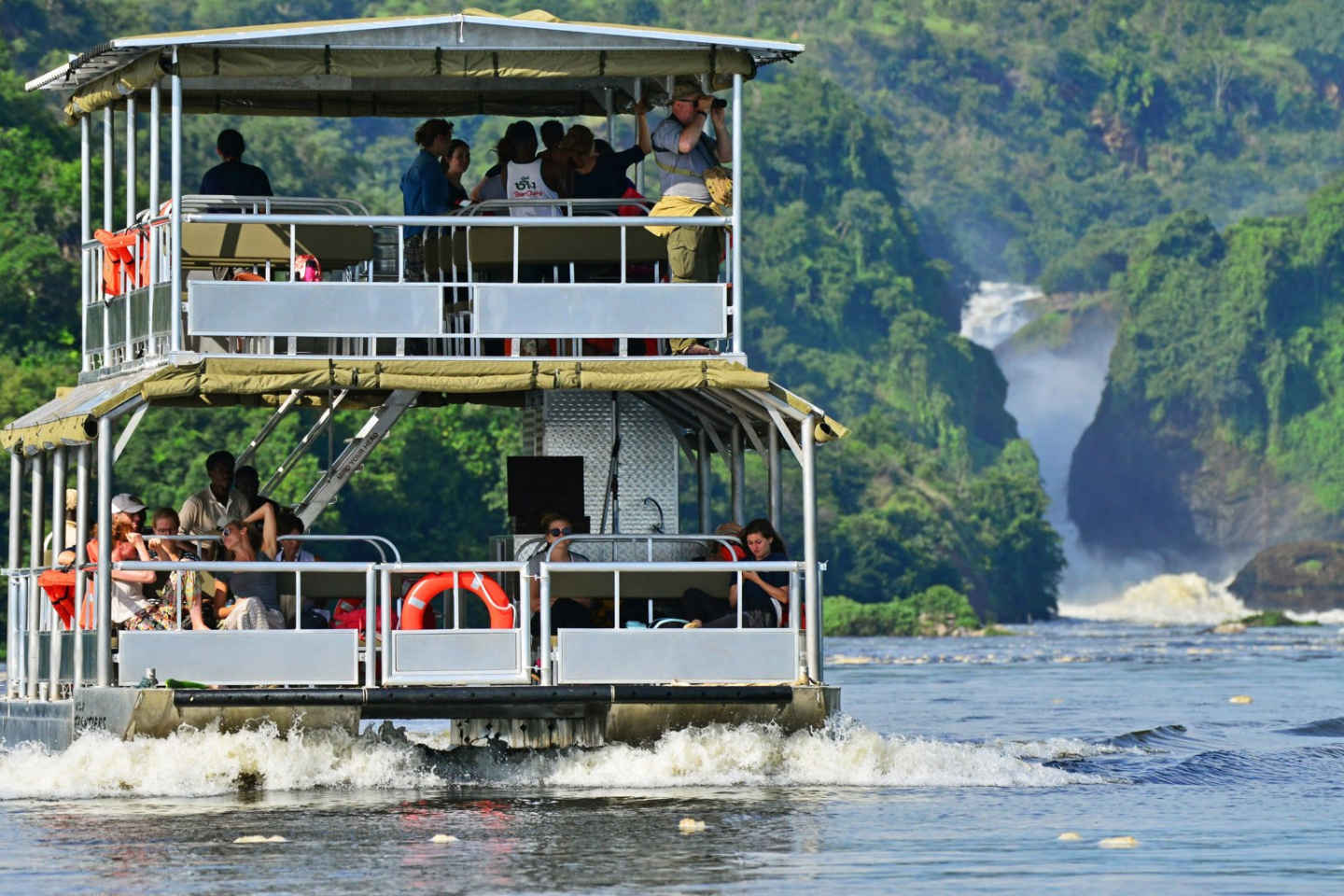
The park itself supports lions, elephants, giraffes, buffalo, hippos, crocodiles, chimpanzees in the Budongo Forest Reserve, and over 450 bird species including the prehistoric-looking shoebill stork, one of the most sought-after birds in Africa. A Nile boat cruise from Paraa to the base of the falls allows you to watch hippos yawn at arm’s length, crocodiles sunning on the banks, and elephants crossing the river in the distance, all while the falls grow from a sound on the horizon to a physical force that vibrates in your chest.
Best Time to Do a Kenya and Uganda Combined Safari
Both countries have year-round wildlife viewing, but the timing of a combined trip affects several specific experiences significantly. Here is the honest seasonal picture.
June to October:
This period aligns the best game viewing in both Kenya and Uganda with the most reliable trekking conditions in Bwindi. In Kenya, the Wildebeest Migration reaches the Maasai Mara between July and October with the most dramatic river crossings typically occurring in August and September. In Uganda, the June to October period coincides with the dry season when forest trails in Bwindi are firmer and gorilla treks, while never easy, are somewhat less physically demanding than in the wet season. This is the period when the Kenya and Uganda combined safari is at its most spectacular and also its most expensive and most in demand. Book everything well in advance, with gorilla permits secured first.
December to February:
The short dry season from December through February is the second-best window for both countries. Kenya’s parks are excellent for wildlife viewing, the weather is warm and mostly dry, and the crowds at the Maasai Mara are meaningfully thinner than the July to October peak. Uganda’s Bwindi is in its shorter dry season with reasonable trekking conditions. Christmas and New Year dates attract strong demand for gorilla permits, so book several months ahead for travel in this window.
March Through May:
The long rains run through March to May across much of East Africa. Game viewing in Kenya continues to be productive since the animals are still there and the grass is green rather than gold, producing a different but genuinely beautiful aesthetic particularly for photographers. Uganda’s gorilla trekking is available year-round and the gorillas themselves are no less present in the wet season. The main practical challenge is trail conditions in Bwindi, where heavy rain makes steep muddy slopes significantly more demanding. Lodge rates across both countries drop considerably in this window, which makes it the best value period for the combination.
Sample Itineraries: How to Combine Kenya and Uganda
The following itineraries are starting points rather than fixed scripts. A good tour operator will adjust these structures based on your travel dates, budget, interests, and the specific gorilla families and conservancies with availability.
10 Days Uganda & Kenya Safari
Day 1 and 2: Arrive Nairobi. Giraffe Centre and David Sheldrick Elephant Orphanage. Overnight at Hemingways Nairobi or Karen Blixen Cottages.
Day 3 to 5: Fly or drive to the Maasai Mara. Three full days of game drives with sunset and sunrise drives from a private conservancy camp. Maasai village visit on day four.
Day 6: Return to Nairobi. Connect afternoon flight to Entebbe. Transfer to lodge near Bwindi or overnight Entebbe.
Day 7: Drive or fly to Bwindi. Afternoon briefing and preparation for gorilla trek. Overnight Bwindi lodge.
Day 8: Gorilla trekking permit day. The trek itself, one hour with the gorilla family, post-trek certificate ceremony.
Day 9: Optional second gorilla trek or visit to a Batwa cultural community. Alternative: transfer to Lake Bunyonyi for a peaceful afternoon before departure.
Day 10: Transfer to Entebbe. Afternoon or evening international departure.
14 Days East Africa Safari
Day 1 and 2: Nairobi city wildlife experiences.
Day 3 and 4: Amboseli National Park for elephants and Kilimanjaro views.
Day 5 to 8: Maasai Mara for four full days including the Great Migration if timing allows. Hot air balloon safari on morning of day seven.
Day 9: Nairobi to Entebbe flight. Transfer north toward Murchison Falls.
Day 10: Ziwa Rhino Sanctuary for rhino tracking on foot. Continue to Murchison Falls. Afternoon Nile boat cruise to the base of the falls.
Day 11: Morning game drive in Murchison Falls National Park. Afternoon hike to the top of Murchison Falls for the view from above.
Day 12: Transfer south to Kibale Forest. Morning chimpanzee tracking.
Day 13: Transfer to Bwindi. Gorilla trekking permit day.
Day 14: Second gorilla trek or Batwa cultural experience. Transfer to Entebbe for departure.
How to Start Planning Your Kenya and Uganda Safari
The starting point is your travel dates, which determine gorilla permit availability, which determines everything else. Once you have a date window, secure Uganda gorilla permits first through a licensed Uganda tour operator, then build the Kenya portion of the itinerary around confirmed permit dates.
Work with operators who are licensed and experienced in both countries rather than booking each leg separately through different companies. A single specialist operator who knows both countries well handles cross-border logistics, permit coordination, flight connections, and the inevitable itinerary adjustments that come with wildlife travel far more smoothly than two operators communicating across a border.
Pack for two completely different climates and terrain types. The Maasai Mara needs lightweight neutral-colored safari clothing, good sunscreen, and a camera with reach. Bwindi needs waterproof layers, proper hiking boots with ankle support, long trousers that tuck into socks (the forest ants are a real consideration), and the mental readiness to spend several hours in dense forest with mud up to your knees before arriving somewhere extraordinary.
And then simply go. The Kenya and Uganda combined safari is one of those trips that lives up to everything that has been written about it, which cannot be said of every travel experience offered anywhere in the world. The gorilla will look at you. The lion will ignore you. The Nile will roar. The Mara will stretch forever. And you will come back having understood something about the natural world and about yourself that you did not have before you left.