
Marsabit National Park: Complete Travel Guide
Marsabit National Park protects 1,554 square kilometers around Mount Marsabit, an extinct volcano rising out of the surrounding semi-desert in northern Kenya, roughly 560 kilometers north of Nairobi and not far from the Ethiopian border.
The contrast is the first thing every visitor notices: hours of dry, dusty plains give way to a cool, cloud-fed montane forest wrapped around the mountain’s upper slopes, with crater lakes, strangler figs and thick vegetation that feel completely out of place this far into Kenya’s arid north.
Marsabit also carries one of Kenya’s most storied and best-documented wildlife legacies. Ahmed, an elephant whose tusks were so enormous they reportedly required special presidential protection during his lifetime, lived in this park, and his skeleton and a life-sized statue remain on display at the Nairobi National Museum today. This guide explains what draws travellers to Marsabit, how to plan a visit around its unusual geography, and what to expect from one of Kenya’s more distinctive, lesser-visited parks.
Should You Visit Marsabit National Park?
Marsabit suits travelers who want to understand Kenya’s geographic range beyond the familiar savannah image and who are drawn to the idea of a cool, misty forest sitting improbably atop a desert mountain. If contrast and unusual landscapes interest you more than guaranteed high-density wildlife sightings, this park delivers an experience unlike anywhere else on Kenya’s safari map.
It also suits travelers interested in astrotourism and photography. With minimal light pollution this far from major towns, Marsabit offers some of the clearest night skies available on an organized Kenya safari, and the crater lakes, particularly Lake Paradise, provide striking, little-photographed subject matter for anyone looking to move beyond standard safari imagery.
Where it suits people less is as a quick add-on or a first-time Kenya destination. The distance from Nairobi, roughly 570 kilometres by road, makes this a deliberate, multi-day commitment rather than a convenient stop, and wildlife density, while present, doesn’t match Kenya’s premier savannah parks. This is a destination for travelers with specific interests in its landscape and history, not a default addition to a standard itinerary.
Why Marsabit Is Geographically Unique
Mount Marsabit’s forest exists because of altitude rather than rainfall in the conventional sense. As moist air moving across the surrounding desert rises against the mountain, it cools and condenses into mist and cloud that bathes the upper slopes almost daily, supporting a montane forest, complete with large strangler figs, in a region that receives little direct rainfall. This phenomenon, sometimes called a cloud forest effect, is what makes Marsabit’s dramatic shift from dusty acacia scrub to dense, cool woodland possible within a single ascent.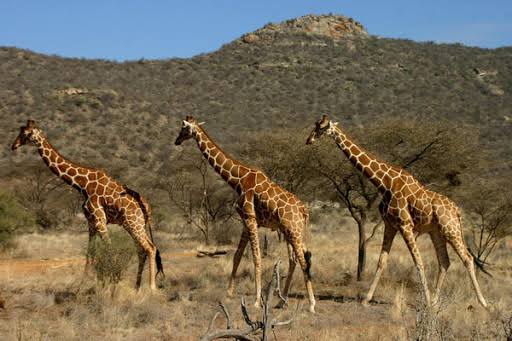
Within this forested crown sit several volcanic crater lakes, the product of the mountain’s eruptive history. Lake Paradise, ringed by cliffs that host nesting Rüppell’s griffon vultures and African fish eagles, is the best known and most photographed, while Gof Redo, a crater roughly five kilometres north of Marsabit town, adds another striking volcanic feature to the park’s geography.
These craters, known locally as gofs, give the landscape a layered, almost otherworldly quality that’s hard to find elsewhere in Kenya.
The park’s elephant population carries real historical weight. Marsabit became internationally known in the 1970s for producing bull elephants with exceptionally long tusks, a reputation anchored by Ahmed, whose tusks were found to weigh over 300 kilograms combined after his death and whose protection during his lifetime became a symbol of Kenya’s broader elephant conservation effort.
Where Is Marsabit and How Do You Get There?
Marsabit sits in Marsabit County in northern Kenya, roughly 570 kilometers from Nairobi via Nanyuki and Isiolo along the now fully tarmacked A2 highway, which continues north to Moyale on the Ethiopian border. The drive takes a full day, and most travelers break the journey with an overnight stop en route rather than attempting it in a single push.
Flying offers a considerably faster alternative, with an airstrip in Marsabit town roughly four kilometers from the park’s Abdul Gate, which also leads to the park headquarters and the main guesthouses. Charter flights from Nairobi are the standard approach for travellers with limited time who still want to include this park in their itinerary.
The park has three main entry gates, Ahmed, Ajmarko and Karare, alongside Abdul Gate for headquarters access, and a 4×4 vehicle is recommended for navigating the mix of forest and open terrain within the park’s boundaries.
When to Visit: Seasons and Weather
Marsabit’s elevation moderates temperatures considerably compared with the surrounding desert, making it noticeably cooler than destinations like Samburu or Buffalo Springs at similar latitudes. Mist and cloud cover are a near-constant feature of the upper forest regardless of season, which is part of the park’s character rather than something to plan around avoiding.
| Season | Months | What to Expect | Best For |
| Long dry season | June – October | Easier road access on the long drive north, clearer conditions for astro-tourism | General visits and night sky photography |
| Short dry spell | January – February | Similar dry-season advantages, quieter visitor numbers | Travellers prioritizing solitude |
| Long rains | March – May | Heavier rainfall, more difficult road conditions on the approach drive | Flexible travellers comfortable with logistical trade-offs |
| Short rains | November – December | Intermittent showers, lush forest conditions | Birders and photographers drawn to a greener landscape |
Given the length of the drive from Nairobi, dry-season travel is worth prioritizing less for conditions within the park itself and more for a smoother, more predictable journey on the approach roads.
How Much Does a Visit Cost
| Component | Cost (Non-Resident) | Notes |
| Park entry, adult | USD 40 per day | Children pay USD 20; East African citizens and residents pay considerably less under local rates. |
| Accommodation | USD 30 – 150 per night | Ranges from public campsites to Mbugani Homes and nearby privately owned lodges |
| Vehicle and guide | USD 30 – 60 per day | Essential given the park’s mixed forest and open terrain |
| Charter flight from Nairobi | USD 300 – 600 per person, one way | Shared charters can reduce per-person cost significantly. |
Where to Stay
Mbugani Homes
The park’s main accommodation option near headquarters, offering straightforward, comfortable lodging within easy reach of the forest trails and Abdul Gate.
Public Campsites
Ahmed and Abdul campsites offer basic facilities for travelers with their own equipment, while the special Lake Paradise campsite gives a rare opportunity to camp directly beside one of the park’s most scenic crater lakes.
Marsabit Town
A range of privately owned hotels and guesthouses in Marsabit town, just outside the park, offer additional options for travelers who want a town base with easy park access each day.
What to Do in Marsabit
Wildlife Drives, Including Night Safaris
Game drives cover greater kudu, Grévy’s zebra, reticulated giraffe and leopard, with the park’s night safari option offering a markedly different wildlife-viewing experience from the standard daytime game drive found elsewhere in Kenya.
Birdwatching at the Crater Lakes
With around 350 recorded bird species, including 52 birds of prey, the crater lakes, particularly Lake Paradise, offer some of the park’s richest birding, with raptors regularly seen nesting on the surrounding cliffs.
Forest Walks and Hiking
Guided walks through the montane forest let visitors experience Marsabit’s unusual cloud forest ecosystem up close, including its large strangler figs, in a way that a vehicle-based game drive alone can’t match.
Astro-Tourism
Minimal light pollution this far from major urban centers makes Marsabit a strong destination for night sky viewing and photography, a feature increasingly highlighted by the park’s own tourism promotion.
Cultural Visits
Visits to traditional singing wells and the Marsabit Cultural Museum offer insight into the pastoralist communities of this region, adding a cultural dimension to the park’s natural and geological attractions.
Combining Marsabit with a Wider Northern Kenya Circuit
Given the distance and time commitment involved in reaching Marsabit, most travelers who include it do so as part of a longer northern Kenya itinerary rather than a standalone trip. A common approach links Marsabit with the Samburu ecosystem, Samburu, Buffalo Springs and Shaba, further south, building a multi-stop route that takes in both the arid-adapted wildlife of those reserves and Marsabit’s distinct forested mountain terrain.
Some itineraries extend further north still, using Marsabit as a staging point before continuing toward Lake Turkana, Kenya’s remote Jade Sea, for travellers with the time and appetite for a truly off-the-beaten-path extension.
This kind of routing requires careful planning around road conditions and travel time and is best arranged through an operator with direct experience in this specific part of Kenya rather than attempted as an improvised addition to a standard safari booking.
Who Marsabit Suits Best
| Traveller Type | Fit | Why |
| Travellers interested in unusual landscapes | Excellent | A cloud forest and volcanic crater lakes rising directly out of desert terrain |
| Astro-photographers | Excellent | Minimal light pollution and clear night skies |
| History and conservation enthusiasts | Strong | Direct connection to Ahmed and Kenya’s big-tusker elephant legacy |
| Birders | Strong | Around 350 recorded species, with strong raptor activity at the crater lakes |
| First-time Kenya visitors on a tight schedule | Not recommended | The long distance from Nairobi makes this a deliberate, multi-day commitment rather than a convenient addition |
Frequently Asked Questions
Who was Ahmed the elephant, and can I learn more about him at the park?
Ahmed was a Marsabit bull elephant famous for his exceptionally large tusks, placed under special protection during his lifetime. His skeleton and a life-sized statue are displayed at the Nairobi National Museum, and his legacy remains closely associated with the park’s own history and conservation story.
How long does it take to drive from Nairobi to Marsabit?
The drive covers roughly 570 kilometres via Nanyuki and Isiolo on the tarmacked A2 highway, typically taking a full day. Most travellers break the journey with an overnight stop rather than driving it in one continuous trip.
Why is there a forest on top of a mountain in the desert?
Moist air rising against Mount Marsabit cools and condenses into near-constant mist and cloud cover on the upper slopes, supporting a montane forest ecosystem despite minimal direct rainfall in the surrounding lowland desert.
What makes Lake Paradise worth visiting?
This crater lake, ringed by cliffs hosting nesting Rüppell’s griffon vultures and African fish eagles, offers some of the park’s most striking scenery and birding, along with a dedicated special campsite for travellers wanting to stay directly beside it.
Is a night safari worth including in my itinerary?
Yes, if your schedule allows it. Night safaris offer a different wildlife-viewing experience from standard daytime drives, with a real chance of nocturnal species activity not visible during the day.
Can Marsabit be combined with other northern Kenya destinations?
Yes, though the distances involved require careful planning. Some travellers combine Marsabit with Samburu, Buffalo Springs or Shaba further south, building a longer northern Kenya circuit rather than treating Marsabit as an isolated stop.
What wildlife am I most likely to see on a Marsabit game drive?
Greater kudu, buffalo, giraffe and both colobus and blue monkeys are regularly encountered, with Grévy’s zebra and leopard also present though less reliably seen. Elephant sightings continue the park’s long association with the species, even if tusks of Ahmed’s scale are now exceptionally rare anywhere in Africa.
Planning Your Visit
Marsabit rewards travellers willing to commit real time to reaching it, and that commitment is really the central planning question here. Decide early whether the long road journey or a charter flight fits your itinerary and budget better, and build in enough time once you arrive to properly explore both the forest and the crater lakes rather than rushing through on a single short visit.
Pack for both climates on the same trip: lighter clothing for the hot, dry lowlands you’ll pass through on the way up, and a warmer layer for the noticeably cooler, often misty forest once you reach the mountain itself. This temperature swing catches some travellers off guard, and a flexible packing list makes the transition far more comfortable.
If you’re considering Marsabit as part of a longer northern Kenya itinerary, or want help weighing the road versus flight decision against your overall trip plan, our team can talk through what makes sense for your timeline and interests.


