
Elsa’s Kopje | Meru National Park Kenya
Few safari lodges in Africa carry a history as genuinely moving as Elsa’s Kopje. Built on the very hillside where conservationists George and Joy Adamson raised the orphaned lioness Elsa, whose story became the bestselling book and Academy Award-winning film Born Free, the lodge sits in Meru National Park as both a luxury retreat and a living tribute to one of the twentieth century’s most influential conservation stories.
We place Elsa’s Kopje on itineraries specifically for clients who want a genuinely quiet, uncrowded park paired with a story that adds real emotional depth to the wildlife viewing itself, since Meru remains one of Kenya’s most underrated destinations despite its rich history and consistently strong game, and it’s rare to find a lodge that has won an award for Best Safari Property in Africa while still carrying such a personal, human story at its center.
The Story Behind the Name
In 1956, George Adamson, then senior wildlife warden of Kenya’s Northern Frontier District, and his wife Joy rescued three orphaned lion cubs after their mother was killed in self-defense near the Ura River. One of those cubs, a lioness named Elsa, became the centre of an extraordinary experiment: rather than keeping her in captivity, the Adamsons chose to raise her with minimal human dependence and, in 1958, released her back into the wilderness that is now Meru National Park, where she went on to mate and raise her own cubs before dying of a tick-borne illness in George’s arms in 1961, at just five years old.
Joy’s book about their life together, Born Free, became a global bestseller, and the 1966 film adaptation is widely credited with reshaping public attitudes toward wild animals at a time when most on-screen depictions still framed them as dangerous, savage creatures.
Elsa’s Kopje was built in 1999 by renowned Kenyan safari figures Liz and Stefano Cheli, co-founders of Cheli & Peacock Safaris, both of whom were personally inspired by the Adamsons’ story, and the lodge sits close to Mughwongo Hill, where George and Joy would hike with Elsa to watch the sunrise.

The property was later sold in 2014 to Elewana Collection, which continues to operate it today, and the lodge itself is widely credited with rescuing Meru National Park from years of decline and obscurity, drawing renewed international attention back to a park that had once been largely forgotten by the safari industry.
Retracing the Adamsons’ Story
Guests staying at Elsa’s Kopje can arrange guided visits to several sites connected directly to this history: Elsa’s grave, where part of Joy Adamson’s ashes were also later scattered; the grave of Pippa the cheetah, another animal the Adamsons worked with; George’s Pool, his favourite spot for sundowners and a place he brought his lions to swim; and the site of Kampi ya Simba, meaning “Camp of Lions,” where George lived for four years before relocating to a more permanent base in the adjacent Kora Reserve.
The lodge’s management and guiding team keep this history genuinely alive for guests rather than treating it as a footnote, and a display of photographs from the Adamsons’ years at Mughwongo Hill remains on view at the property today.
This history adds a genuine emotional dimension to a stay here that’s difficult to replicate anywhere else in Kenya, and guides at the property are typically well-versed enough in the Adamsons’ story to answer detailed questions well beyond the basic outline most visitors already know from the film.
Past guests consistently describe being driven to Elsa’s grave and George Adamson’s grave as one of the most memorable parts of an already memorable stay, particularly when timed around a special occasion.
The Cottages
Elsa’s Kopje offers ten accommodation units in total, each open-fronted and individually shaped by the specific rock formations surrounding it, so no two are identical. Six standard cottages form the core of the property, each with a main bedroom, en-suite bathroom, and a private deck or veranda (one, Cottage 3, has a private sitting room instead of a deck), and two of these can accommodate an extra bed for children under sixteen.
Three dedicated Honeymoon Suites overlook the vast plains of Meru specifically, positioned for privacy and panoramic sunrise views, making them a genuinely popular choice for couples marking a special occasion.
For families or groups wanting more space, the Family Cottage offers two en-suite bedrooms, a double and a twin, sharing a beautiful living room, a large private deck, and an outdoor bath positioned by the master bedroom. Elsa’s Private House sits slightly apart from the main lodge entirely: a spacious, exclusive two-bedroom hideaway with its own living and dining area, a private garden, and its own swimming pool, along with a dedicated private guide for the length of the stay, genuinely well suited to a family or small group wanting total independence from the rest of the lodge’s schedule. Power runs 24 hours a day throughout the cottages for lighting and charging devices, and Wi-Fi is available in all rooms and public areas despite the park’s genuine remoteness.
Amenities
The main lodge area is built around an infinity pool carved directly from the rocky hilltop, positioned to take in sweeping views across Meru’s plains, alongside an open-sided lounge, dining area, library, and small on-site gift shop. Meals draw on fresh, seasonal ingredients and are served both in the main dining area and, on request, at more intimate settings elsewhere on the property, including private bush breakfasts, sundowners at a dedicated viewpoint, and dinners arranged among the kopje’s boulders under the stars. The lodge’s full-board rate includes soft drinks, beer, house wines, selected spirits, teas, coffees, and laundry, with only champagne, private cellar wines, and premium spirits charged separately.
Given Meru’s genuine remoteness relative to Kenya’s more visited parks, the lodge maintains a self-sufficient, well-stocked bar, and the region’s low population density also means Elsa’s Kopje sits in a genuinely low malaria-risk area relative to some of Kenya’s other parks, worth knowing when planning health precautions for the trip. The lodge’s staff, many drawn from the local community around the park, bring a genuinely warm, personal quality to service that repeat guests consistently mention, and children of all ages are welcome throughout the property.
The Lodge and Meru National Park
Meru itself remains one of Kenya’s quieter, less-visited parks, a genuine advantage for travelers seeking a wilder, more solitary safari experience away from the vehicle density that can affect the Mara during peak season.
At 870 square kilometres, or roughly 215,000 acres, the park is recognized as having a greater diversity of animal species than any other park in East Africa, and its varied terrain, riverine forest, open grassland, doum palms and baobab trees, and the Tana River forming its southern boundary, supports this genuinely diverse range of wildlife within a relatively compact, easily explored area.
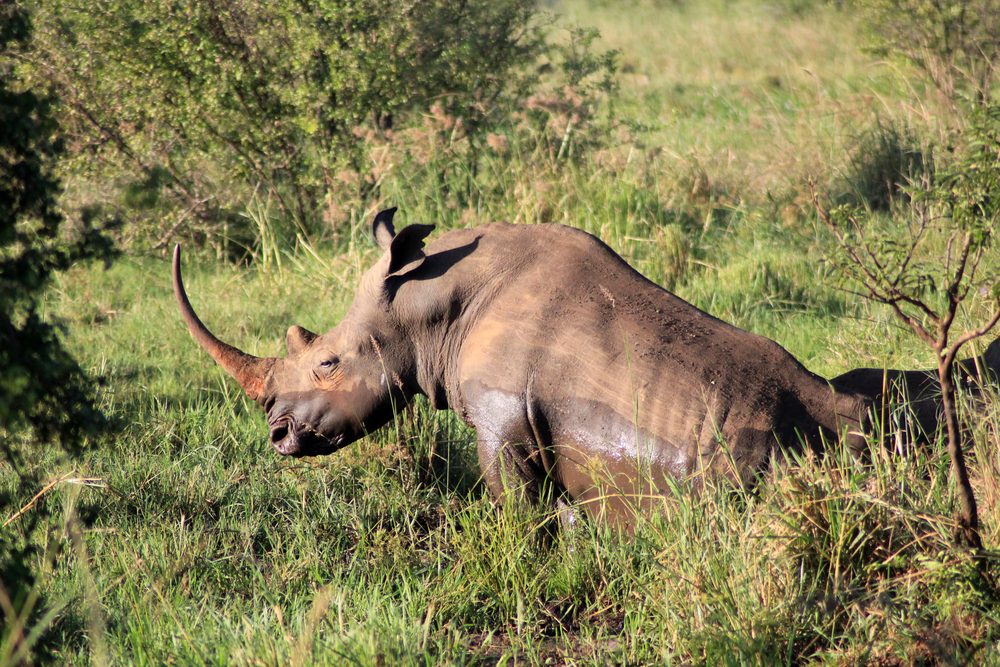
Activities include game drives in open 4×4 vehicles with knowledgeable driver-guides in search of elephant, lion, leopard, hippo, and the park’s growing black and white rhino population within its dedicated sanctuary, alongside guided walks, night game drives, and even a rafting trip on the Tana River, offering a genuinely unique way to view wildlife from the water. Birdlife across Meru’s varied habitats is also excellent, with over 300 recorded species rewarding guests with even a casual interest in birding.
Best Time to Visit
Meru’s dry seasons, June through October and January through February, offer the best game viewing as wildlife concentrates around the park’s rivers and remaining water sources. As with Kenya’s other savanna parks, this timing isn’t governed by a migration event but simply by seasonal water and grazing patterns, making it a somewhat more straightforward decision than planning around the Mara’s migration calendar.
The wetter months bring dramatically lush, green scenery and excellent birdlife as migratory species arrive, along with meaningfully lower rates and virtually no crowds, though Meru already sees so few visitors relative to its size that crowding is rarely a genuine concern here even during the busier months.
Given its relative remoteness, most itineraries pair a Meru stay with at least one other Kenyan destination rather than treating it as a sole safari focus, and Elsa’s sister property in the Mara North Conservancy offers a natural, complementary pairing for travelers wanting to combine Kenya’s two quieter, game-rich wildernesses in a single trip.

Why It’s Worth the Price
Elsa’s Kopje sits at a genuinely accessible luxury price point relative to the Mara’s top camps, reflecting both Meru’s lower general demand and the lodge’s slightly more rustic, boulder-built character compared with some of Kenya’s more polished contemporary properties.
What the price buys is a setting and a story genuinely unavailable anywhere else on the continent: a chance to walk the same hillside where one of conservation history’s most influential relationships between humans and wildlife actually took place, combined with excellent, uncrowded game viewing in a park most visitors to Kenya never see, and an award-winning level of guiding and hospitality that has kept this small, remote lodge on Africa’s best-property lists for decades.
For clients building a second or third Kenya trip and looking for something genuinely different from the well-trodden Mara circuit, Elsa’s Kopje offers both the history and the solitude to make that difference feel meaningful rather than merely novel.